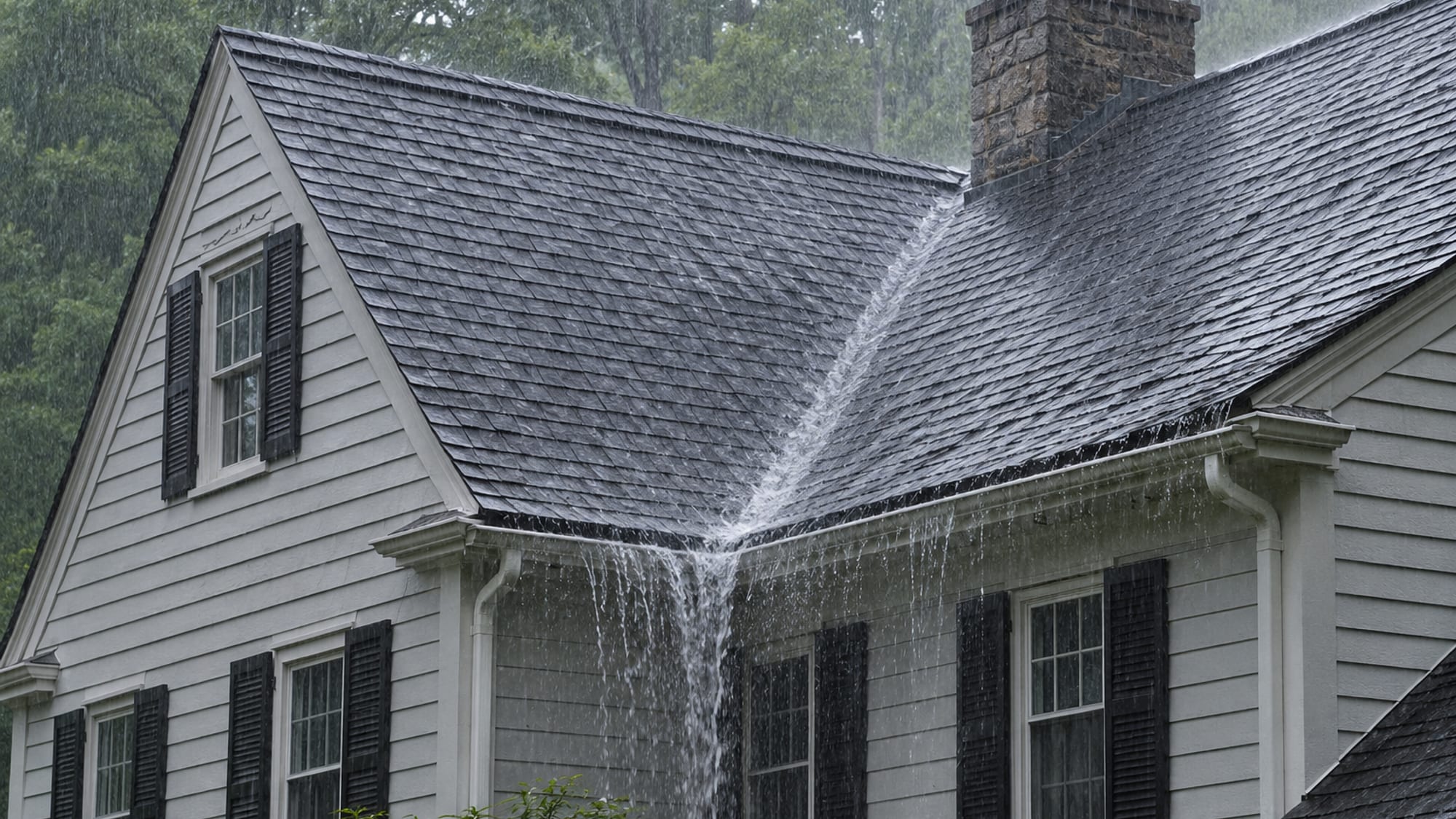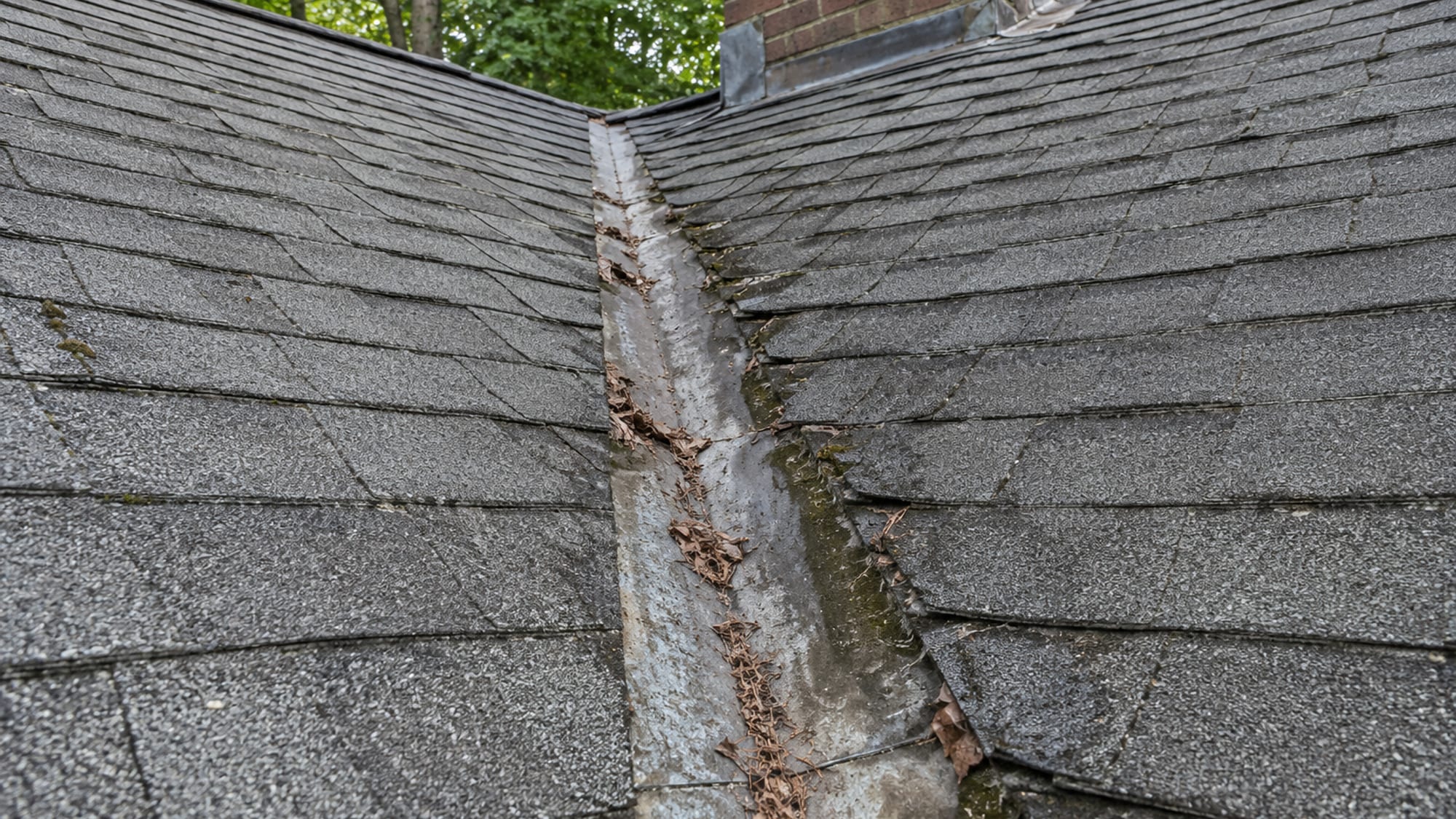
Roofing Guide
How to Find a Roof Leak in a Connecticut Home, Step by Step
By Jose ZarumaPublished
- roof leaks
- roof repair
- connecticut

Put a container under any drip, move what you can out of the way, and write down when the water shows up. That timing note tells you more about the source than the stain does, and it is the first thing a roofer will ask you.
Here in Connecticut, a stain that appears on the first mild afternoon after a snowfall points somewhere different than one that shows up during a Tuesday-night downpour or only when someone runs the shower. You can narrow the list from the ceiling, the attic and your own driveway, and none of it takes a ladder or a step onto the roof.
Water also rarely drips where it gets in. By the time it reaches the drywall it may have run along decking, framing or insulation for several feet, so the first stain is a clue, not an address.
Key Takeaways
Timing narrows the source
Water during rain or snowmelt points toward the roof, while water that appears when a shower, washer or dryer runs points toward plumbing or a duct.
The stain is a clue, not the address
Water can travel along sheathing, framing and insulation before it shows up, so follow the wet trail uphill in the attic.
Ground and attic checks have limits
They can shorten the list of suspects, but they cannot rule out a concealed defect.
Stay off the roof
Wet shingles, ice and steep pitch are fall hazards, and any water testing on a roof belongs to a professional.
A good inspection names five things
The suspected entry point, photos, moisture readings, whether temporary protection is needed, and a repair scope.
Insurance follows the policy
Photograph the damage before permanent repairs, and ask your insurer what your declarations page and exclusions say.
Start With a Bucket, a Camera and a Notebook
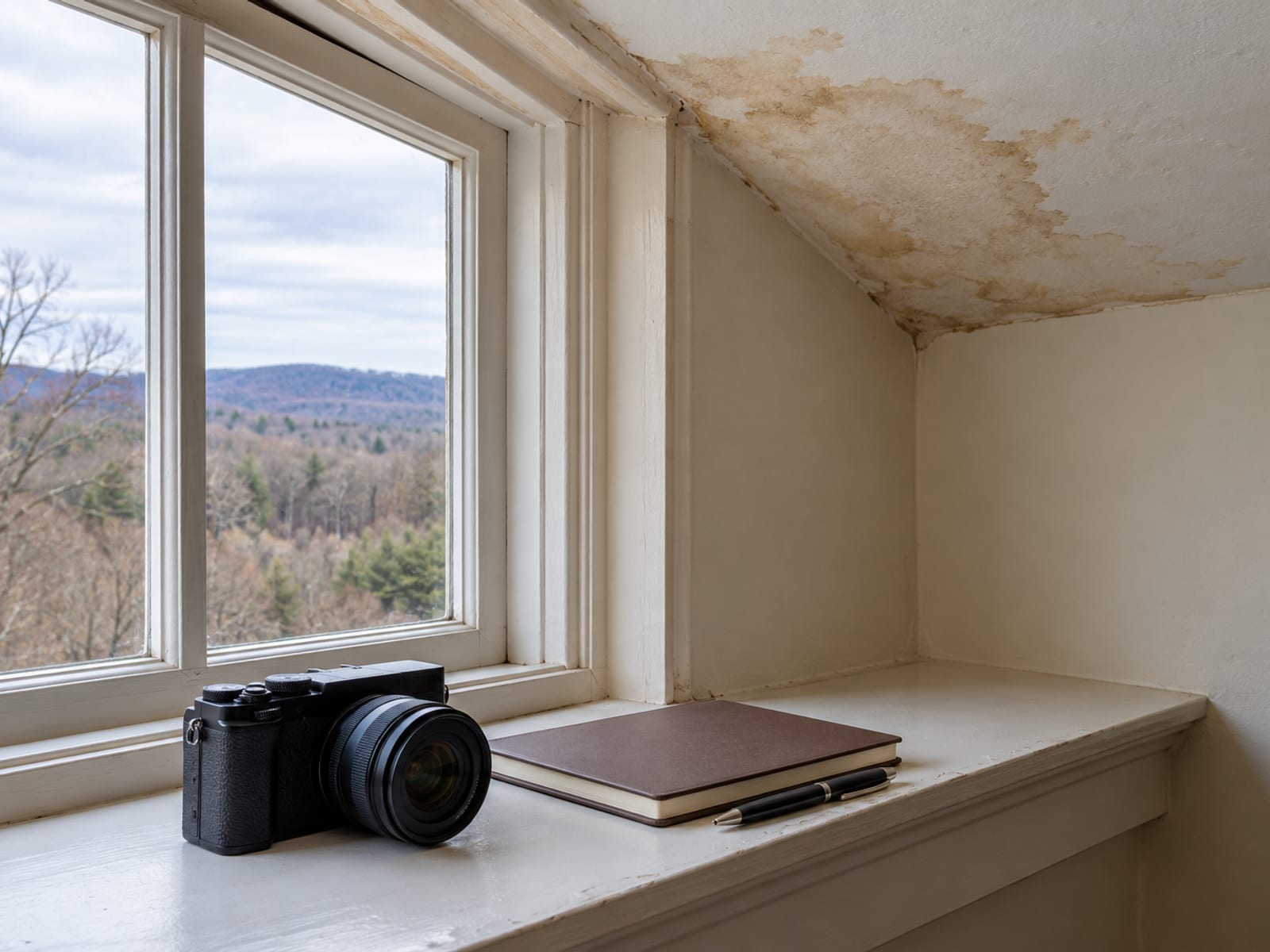
The first hour is about limiting damage and keeping clues that disappear once the ceiling dries. Set a bucket or tub under active water, and move furniture, rugs and anything electrical out of the drip zone. Then photograph the stain, the dripping water and the room, so you can show a roofer or an insurer how it looked before anything changed.
- Steady rain or wind-driven rain
- Snowmelt or a warm spell after a storm
- Cold weather with no rain or snow at all
- A shower, bath, toilet flush, dishwasher or laundry cycle
- The heat or air conditioning running
A pattern across two or three events is worth more than any single drip. If you can safely do it, photograph the attic from the hatch too, and take a few photos of the outside of the house from the ground.
Safety comes before detective work. If water is near a light fixture, wiring, an electrical panel or an appliance, stay away from that spot and have an electrician or an emergency professional look at it. If the ceiling is bulging, sagging or cracking quickly, keep people out of that room and arrange urgent professional help.
Whatever the cause, stay off the roof. Wet roofing, ice and steep pitch make it a fall hazard, and a hose aimed at a roof is a test for professionals who control where the water goes and stop if it threatens to enter the house.
Last, think about the clock. EPA's guide to mold and moisture in your home says wet materials should be dried promptly, and it gives 24 to 48 hours as the window in which drying commonly prevents mold growth. Open windows, run fans and pull up soaked rugs while you work out the source.
Work From the Ceiling Up Until You Reach the Wet Spot
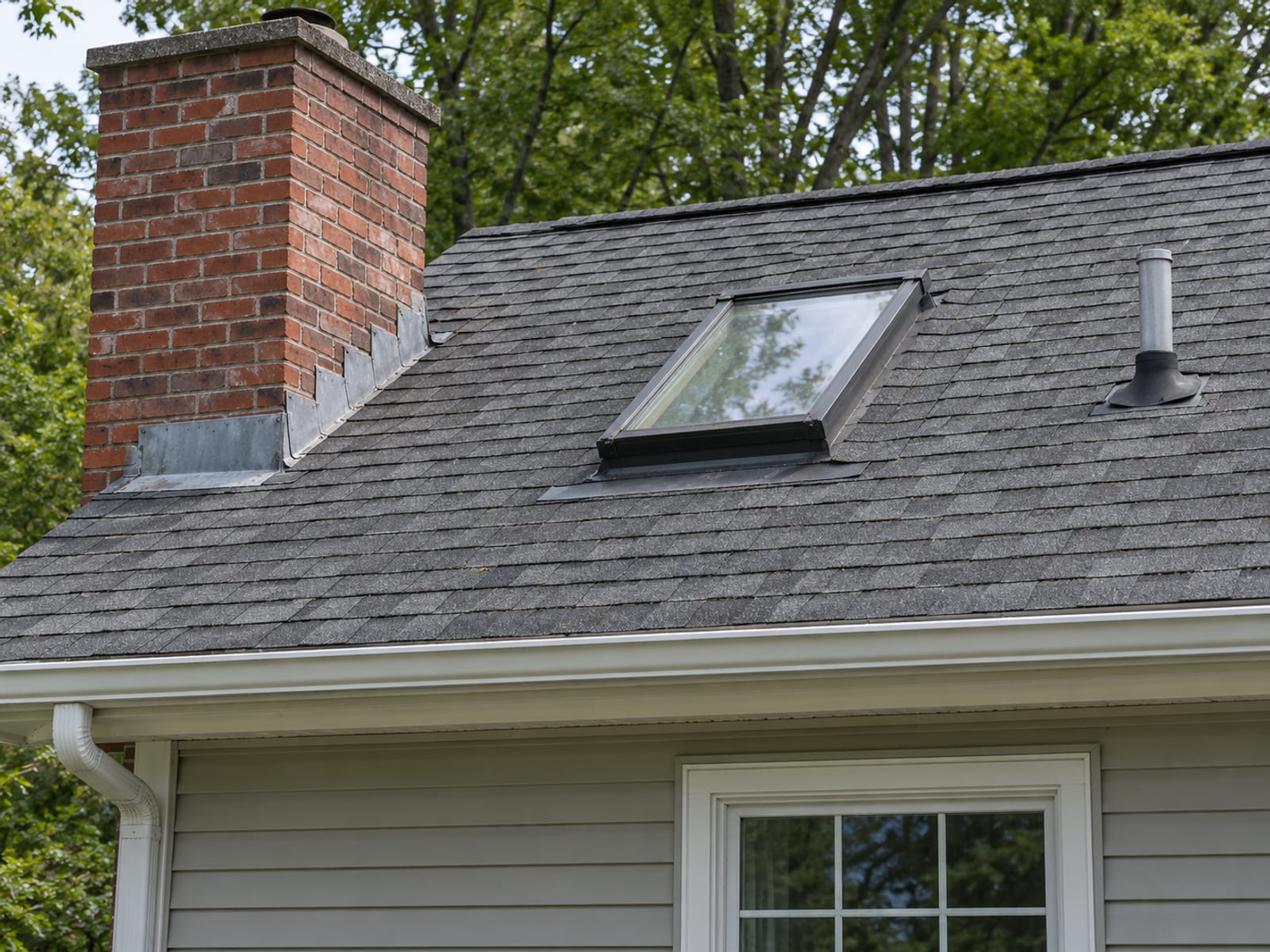
Start in the room with the stain and ask what sits above and beside it. Look for a chimney, a plumbing vent pipe, a skylight, a valley (the line where two roof slopes meet), a dormer, a roof vent or an exterior wall. The closer the stain sits to one of these, the shorter your list of suspects, though a stain directly under one is useful evidence rather than proof.
Then, if you have a hatch or a floored path into the attic, take a flashlight and look from the hatch or from a stable spot on the framing. Stay on the joists, skip it if you cannot reach comfortably, and leave it alone if wet insulation sits near wiring. Here is what you are looking for:
- Wet, compressed or discolored insulation
- Dark stains on the underside of the roof boards, which are called sheathing
- Damp rafters or wall framing
- Rusted nails or fasteners
- A visible wet trail on wood
Find the wettest spot, then follow the trail uphill and toward the nearest roof penetration or the place where the roof meets a wall. That is usually where the opening is. ENERGY STAR lists wet insulation, moldy or rotted attic framing and poor attic ventilation among the warning signs of a moisture problem, so those findings matter even when nothing is dripping.
You can also have a leak with no drip at all. A small or intermittent leak may wet insulation or framing for a long time before the ceiling shows anything. It may appear only in wind-driven rain, with one wind direction, or during a freeze and thaw cycle. Peeling paint, swollen drywall, a musty smell and water marks on rafters, framing or window trim are all indirect evidence worth writing down.
A Walk Around the House Shows What the Attic Cannot
Once you have a suspect area from the inside, go outside and look at that part of the roof from the ground. Binoculars help. You are looking for missing, lifted, cracked or visibly damaged shingles, displaced flashing (the metal that seals joints and edges), damaged rubber boots around plumbing pipes, roof debris, and gutters that are blocked or overflowing, since water that backs up at the eave has to go somewhere.
Check the siding and trim below the roofline as well. Unusual water marks can show where water has been running down the outside of the wall. Wind-driven rain can also enter at window corners, siding joints and wall penetrations, then travel inside the wall and show up as a stain on an upper wall or ceiling, away from the real opening.
Know the limits of this walk-around. It can point you toward a damaged boot, a lifted shingle or a clogged gutter. It cannot rule out a concealed defect, such as failed flashing hidden under siding or a small gap you cannot see from the ground. A clean-looking roof from the driveway does not mean a dry roof.
The Stain Is Often Several Feet From the Opening
Water gets in where the roof covering, the flashing and the wall or pipe have to work together. According to Building Science Corporation, drainage planes and flashing are the systems that direct water away from the building, and defects at those transitions can send water into hidden parts of the structure.
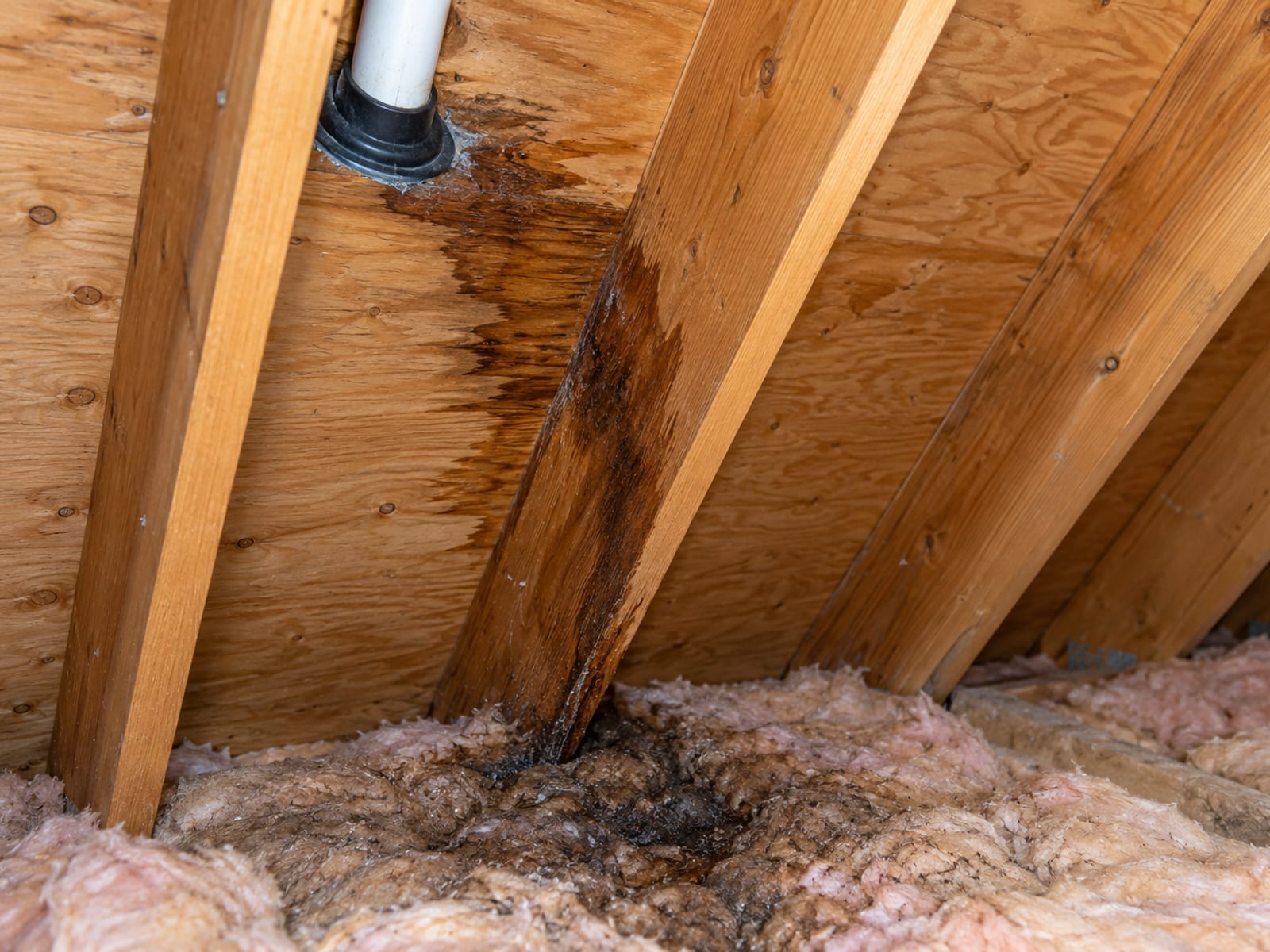
From there, water does not fall straight down. It can run along the roof deck, slip under roofing, pass through flashing laps, and follow framing or insulation before it reaches your ceiling. The entry point may be higher up the slope or at a nearby joint, even when the stain sits right under a chimney, skylight or vent pipe. Building Science Corporation's guides on rain control in buildings and wood pitched roof construction cover the same water paths.
Where to Look First for Each Stain Location
Chimney flashing and the sidewalls, then the slope above it
Tap a factor to see how it moves the price.
Plumbing, Condensation and Ice Dams Can Pass for a Roof Leak
Not every ceiling stain comes from the roof. Plumbing lines, bath and kitchen fans, a dryer duct and cold-weather condensation can wet a ceiling just as well, and Connecticut's freeze-thaw winters add ice dams to the list. Timing is the quickest way to sort them out, though it narrows the search without proving the cause.
What the Timing Tells You
Points Toward: A plumbing source
Next Step: Call a plumber; slow pipe leaks may not show water every time a fixture runs
Tap a factor to see how it moves the price.
Ducts deserve a closer look. A bath fan, kitchen exhaust or dryer duct that ends in the attic instead of outdoors can release warm, moist air into a cold roof space, where it condenses on sheathing, nails and framing. ENERGY STAR flags that setup as a moisture problem. Winter condensation also happens when warm indoor air leaks through gaps in the ceiling into the cold space under the roof, and Building Science Corporation notes that ventilation alone may not fix heavy air leakage or high indoor humidity.
Ice dams form when snow melts on the warmer part of a roof and refreezes at the colder eaves, trapping water that can then work its way under the roofing. The University of Minnesota Extension explains ice dams and how to prevent them. Recessed lights, skylights, complicated roof shapes and ducts in the attic can raise the risk. Snow-covered and icy roofs are a fall hazard, so that work stays with professionals.
Some of these answers need a different trade. A plumber handles supply and drain lines, an HVAC contractor handles duct terminations, and an electrician should check any wiring that got wet. Hidden mold or moisture inside walls may call for a building or remediation professional. A good roofer will tell you when the roof is not the problem.
A Professional Inspection Is Built to Catch the Leak That Keeps Hiding
If you cannot find the source, or you find it and cannot reach it, the next step is a person with the right equipment. A thorough leak inspection often starts inside, with the stained ceiling, nearby walls, ducts and plumbing, and then moves to the attic for wet insulation, moisture trails, stained sheathing, damp framing, rusted fasteners and signs of poor ventilation. The outside inspection happens from safe ground positions and, when conditions allow, professional roof access.
Timing helps. An inspection during rain or shortly afterward makes active water paths easier to see. Moisture meters compare readings on wet and dry materials. Infrared cameras can show wet areas when they are cooler than the materials around them, and Building Science Corporation explains that evaporation and water's thermal mass create those cooler signatures.
When a roofer needs to be sure, a controlled water test comes into play. A professional runs water on a limited section of roof, flashing, wall, window or penetration while someone watches the inside, documents what happens, and stops if the water risks entering the building. That is different from a homeowner with a garden hose, and it is why that test is off the table for you.
At the end of the visit, the inspection should name the suspected entry point, tell you roof water from plumbing or condensation, document visible damage with photos, say whether temporary protection is needed, and give a repair scope. A good report also says plainly when the source cannot be pinned down in dry weather. Painting over the stain before the moisture source is fixed only hides the evidence.
If you are dealing with a leak right now, our leaky roof repair service starts with exactly this kind of diagnosis, and our roof repair work follows from what it finds. For water coming in tonight, our emergency roof services run around the clock.
What a Roof Leak Inspection Costs in Connecticut
The Connecticut Department of Consumer Protection reported in 2025 that the average roof inspection costs $250 to $300. That figure covers an inspection. It is not a repair price, and it does not include emergency service, water mitigation, interior restoration or engineering work, which vary by scope.
If the inspection leads to repair work, ask for a written, itemized scope that separates the diagnosis, any temporary protection, the roofing work, permits, water mitigation and interior repairs, so you can compare one proposal to another line by line. Our guide to roof leak repair cost in Connecticut shows what moves the price.
Insurance Depends on the Policy, So Document First and Patch Second
Whether your homeowners policy pays for a leak depends on its terms, covered perils, exclusions, deductibles and endorsements, according to the Connecticut Insurance Department's homeowners insurance FAQ. Standard policies generally cover certain storm damage and generally exclude flooding. Sudden damage from a covered event such as wind or hail may qualify, while wear, deferred maintenance and a roof that has simply reached the end of its life are generally treated as maintenance.
Read your declarations page for your deductible, exclusions and coverage limits, then call your insurer or agent with the specifics. If a storm may be involved, report it promptly. The department's guidance on homeowners storm claims advises photographing damage before permanent repairs when it is safe, and making only the temporary repairs needed to stop more damage until the insurer has had a chance to inspect. Keep receipts and records of any emergency work.
One more point from the department: in a February 2026 consumer advisory, it reported that insurers commonly look at roof age and condition, missing or lifted shingles, multiple roof layers, unrepaired damage, moss buildup and overhanging limbs when they write or renew a policy. A leak that stays unrepaired belongs on that list.
Connecticut Winters, Older Houses and Town Permits Shape the Diagnosis
Connecticut roofs take rain, wind-driven rain, snow, freezing rain, hail and repeated freeze-thaw cycles, plus nor'easters. NOAA's Connecticut State Climate Summary lists extreme precipitation, inland flooding, nor'easters, winter storms, tornadoes and hurricanes as part of the state's climate, and it notes that a February 2013 blizzard produced more than a dozen roof collapses and that Ansonia recorded 36 inches of snow in 24 hours. A weak flashing joint has plenty of chances to show itself here.
Age matters too. Knowing when your roof was last replaced narrows the list of causes, and you can learn that from the home's build date, tax records, prior permits and replacement invoices. If you have an installer's paperwork, set it aside for the roofer.
On permits, Connecticut's current rules are the 2022 Connecticut State Building Code, which applies to permit applications filed on or after October 1, 2022, and which adopts the 2021 International Residential Code. The Department of Consumer Protection says many home improvement projects need a building permit that must be in hand before work begins, and that the homeowner stays responsible for confirming it was obtained, even when the contractor agrees to pull it.
Your local building official administers the code and makes the call on whether a given repair needs a permit. Brookfield, for example, directs residents to its Land Use Office when they are unsure, and Danbury runs a permit center that coordinates building, zoning, engineering, fire, health and utility reviews. Whatever your town, ask before work starts.
Check Three Things in Writing Before Anyone Starts Work
Before you agree to any work, confirm three things. First, the contractor's Home Improvement Contractor registration should be active in the state's eLicense system; the Department of Consumer Protection treats roofing as home improvement work. Ours is CT HIC #0633301, and you can look it up the same way you would anyone else's. Second, ask for proof of liability insurance, which registrants must carry in at least a $20,000 amount, and confirm it with the insurer.

A few questions separate a real diagnosis from a sales visit:
- Where did the water enter, and what evidence shows it?
- Is it roof water, plumbing, condensation, an ice dam, siding or a window?
- Is temporary protection needed now?
- What happens if the leak comes back?
If a contractor mentions a manufacturer certification, ask for the details and confirm them with the manufacturer. We hold CertainTeed ShingleMaster PRO status, and we are glad to have you check.
Frequently Asked Questions About Finding a Roof Leak in Connecticut
How do I find a roof leak I cannot see?
Look for indirect evidence instead of relying on the ceiling stain. Damp or compressed insulation, darkened sheathing, rusted nails, peeling paint, swollen drywall, a musty smell and water marks on rafters or trim all count. Notice whether the water shows up only after rain, snowmelt, bathing, cooking or laundry, or when the wind blows from one direction.
Could a stain over a bathroom or kitchen be plumbing instead of the roof?
Yes. Water that appears after a flush, shower, sink use or an appliance cycle points to plumbing, and a bath fan, kitchen exhaust or dryer duct that ends in the attic can cause condensation. A roof leak is more likely when the water follows rain or snowmelt, especially near a chimney, valley, wall or skylight. Timing alone does not prove the cause.
Is it normal for a roof to leak in heavy rain?
No. A roof should shed ordinary rain, but heavy or wind-driven rain can expose defects that stay dry in light rain. Wind pushes water against flashing, walls, siding, valleys and penetrations. A leak that shows up only in heavy rain is still a defect that needs to be diagnosed. Our post on roof leaks in heavy rain covers the common entry points.
When is a ceiling stain an emergency?
Treat active water near electrical equipment, a quickly growing bulge, sagging drywall, falling material, visible structural movement or extensive mold as urgent. Keep people out of that area and arrange professional help. A small stain is not automatically an emergency, but it should not be ignored.
What happens if I leave a roof leak alone?
Continued moisture can damage drywall, insulation, roof sheathing, rafters, wall framing, finishes and belongings. EPA notes that mold may grow on wet materials and that long-term moisture can contribute to structural damage. A leak can also get worse in the next rain, thaw or windstorm.
Does homeowners insurance pay for a leaky roof in Connecticut?
It depends on your policy. Sudden damage from a covered event such as wind or hail may be covered, subject to exclusions and your deductible, while wear and age are generally treated as maintenance. Read your declarations page and talk with your insurer or agent before permanent repairs.
Quick Roof Leak Knowledge Check
1. What is the most useful first note to write down when a ceiling starts dripping?
2. In the attic, which sign most strongly suggests a roof leak path?
3. Why can a ceiling stain sit several feet from the real opening?
4. Water shows up only when the shower runs. What does that point toward?
5. Which description fits a safe way to test a roof with water?
Final Thoughts
You can learn a lot from a bucket, a notebook, a flashlight in the attic and a walk around the house. Note when the water appears, trace the wet trail uphill, rule out plumbing and ducts, and remember that the stain is a clue rather than the address. Keep your feet on the ground and in the attic, and leave the roof and any water testing to people with the training and equipment.
A leak that is documented early gives your insurer a clear record to work from, and drying wet insulation and framing promptly can keep a small repair from growing into a bigger one.
If the source stays hidden, or you have found it and want it fixed, American Quality Roofing and Siding serves homeowners across Central and Western Connecticut from our home base in Brookfield. We handle roof repair, skylights, gutters, siding and 24/7 emergency roof services, and we will trace the leak before we quote the fix. Call us or request a free estimate and we will come take a look.
Written by Jose Zaruma, American Quality Roofing and Siding.
← Back to the blog