Roofing Guide
Downspouts and Extensions in Danbury, CT: How Far Is Far Enough?
By Jose ZarumaPublished
- downspouts and
- danbury ct
- connecticut
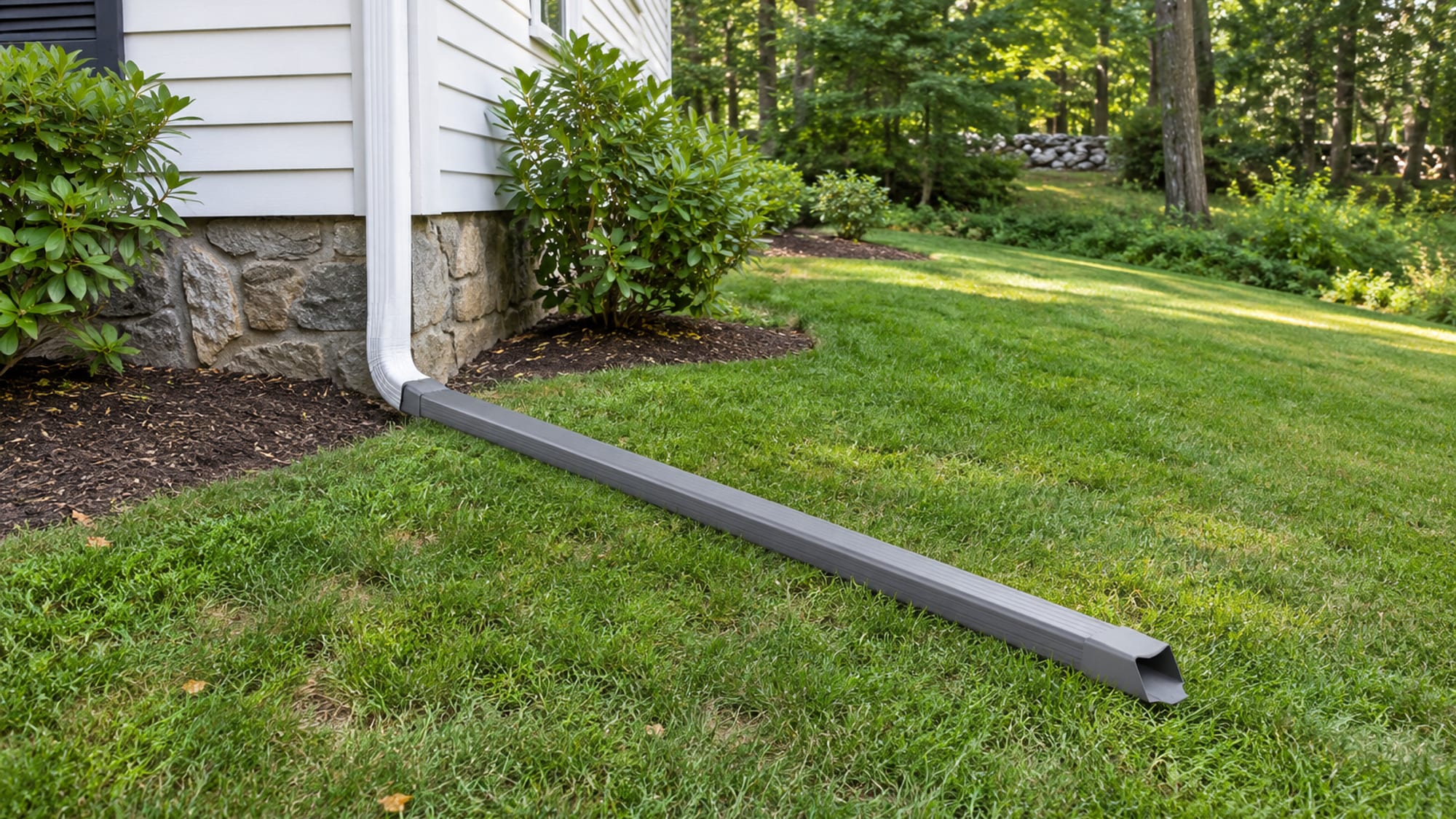
A downspout extension works when it carries roof water across sloping ground, well away from the foundation, and drops it where it cannot find its way back. For surface discharge, ENERGY STAR's water-management guidance and the U.S. Department of Energy's Building Science Education page both put that point at least 5 feet from the foundation. For an underground drain that ends in a catchment system, the benchmark is at least 10 feet.
Those numbers are a good starting point for a Danbury house, but where the water lands matters as much as how long the pipe is. A short extension that empties into a low spot, against a wall, at a property line or into a frozen outlet can leave the basement as wet as it was before.
If you have water along a basement wall, soil washing out under a downspout or a pipe that dumps right beside the house, the downspouts are the place to start. They are one of the easier parts of a wet-basement problem to look at, and often one of the less costly to change.
Key Takeaways
Distance benchmark
Surface discharge should end at least 5 feet from the foundation, and an underground catchment system at least 10 feet away, per ENERGY STAR and the Department of Energy.
The code rule is narrower than it sounds
The International Residential Code's 5-foot provision applies to expansive or collapsible soils or an approved drainage system, so it is not a rule for every Danbury downspout.
Where the water ends up counts
Danbury's grading rules call for drainage away from buildings, no concentrated runoff onto neighboring lots, and no surface drainage onto a City street without City approval.
Price follows the outlet and the digging
Published figures cover gutters and downspout parts, not a buried drain, so a written, site-specific proposal sets the real number.
Winter changes the choice
Danbury sees about 126 days a year at or below 32 degrees, and a roll-out extension is a seasonal product while a buried line must drain so it cannot freeze full.
Deciding How Far Your Danbury Downspouts Should Reach
Most homeowners face the same choice. Either a short surface extension is enough, or the water needs to travel farther through buried pipe, a dry well, a rain garden or another approved arrangement. The answer depends on your slope, your lot and where the water can legally and safely go.
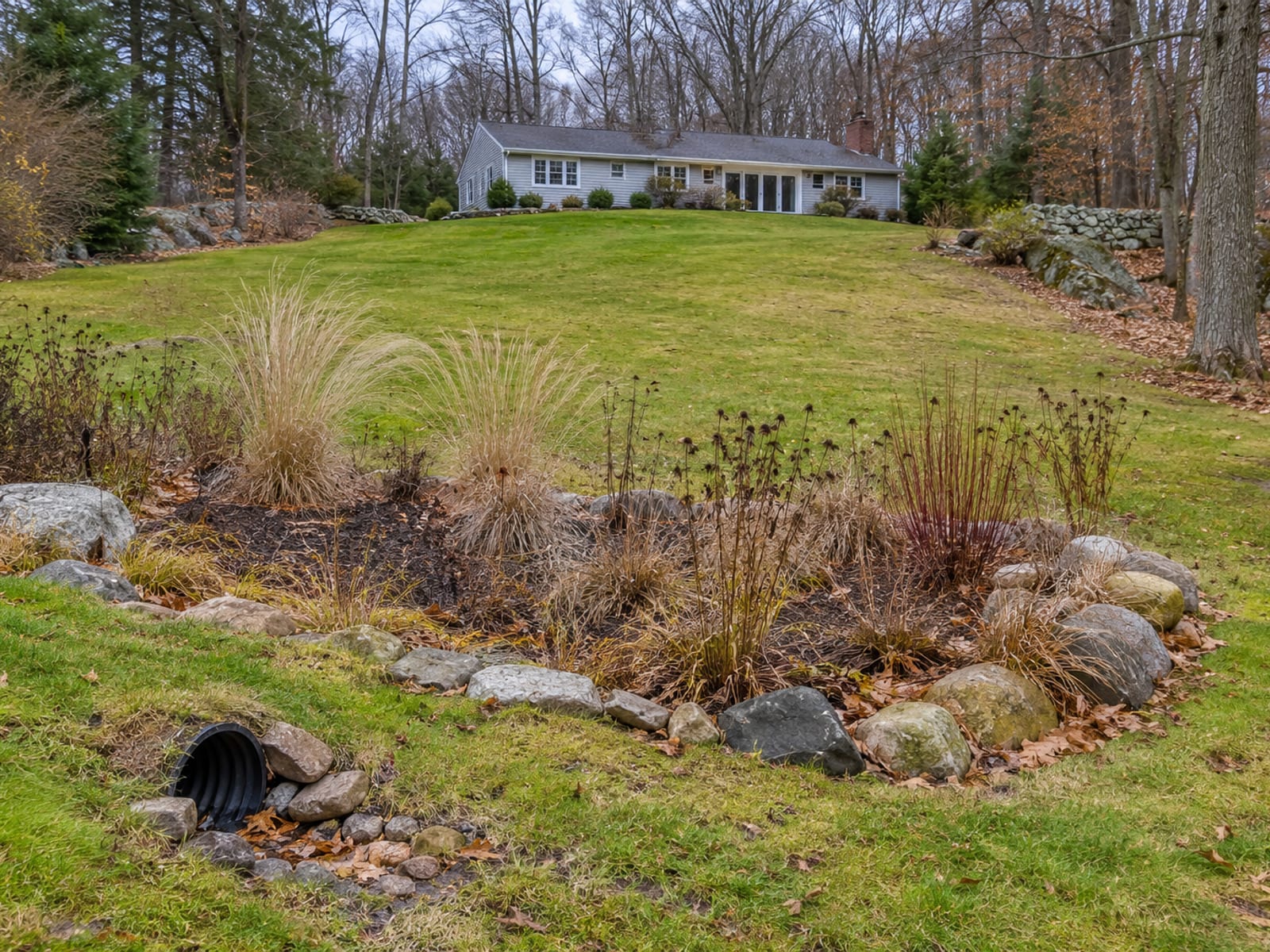
The University of Minnesota Extension gives a practical yardstick for the ground itself. Its guidance calls for an extension that reaches at least 4 feet beyond the wall, with soil that slopes away at least 1 inch per foot for at least 6 feet. Again, that is extension guidance and not a Danbury rule.
Water in a basement does not always come from a downspout. Grading that tilts toward the house, overflowing gutters and foundation drainage can all be involved, so a good inspection looks at every one of them.
Telling Whether a Downspout Is Behind Your Basement Water
A roof gathers a large amount of rain and sends it to a few small openings. When one of those openings empties beside the foundation, the soil there can soak through quickly. Water may then work into cracks, porous masonry, window wells and foundation joints, and wet soil can press against below-grade walls. The Department of Energy describes this chain, and the International Code Council's rain and groundwater TechNote treats grading, gutters, downspouts and foundation drainage as one continuous path for water from the roof to the ground and away.
These are the signs that a downspout may be part of your problem:
- Basement water after rain: Dampness at walls, floors or window wells that shows up during or after a storm.
- Washed-out soil: A bare patch or small trench under a downspout outlet.
- Pooling beside the foundation: Water that stands next to the house instead of draining off.
- A bad destination: An outlet that ends beside a walkway, a driveway, a neighbor's yard or the street.
- A damaged extension: One that is crushed, disconnected, clogged, buried by snow or frozen.
- Overflowing gutters: Leaves, roof debris or ice blocking the outlet and sending water over the edge.
Today, watch each downspout during or right after a rain, and note where every outlet sends its water. Stay on the ground for this; there is no need to get on a ladder or the roof to see where the water lands.
This week, take photos of the drainage paths, check whether the ground slopes away from the house, and clear any blockage you can reach safely from the ground. If the problem needs a permanent change, get a written scope from a registered Connecticut contractor.
Choosing Between Splash Blocks, Surface Extensions, Buried Lines and Dry Wells
The right fix depends on the lot. A flat yard with a narrow side path needs something different from a sloped lawn with plenty of room. Here is how each option works, along with what it asks of you after it goes in.
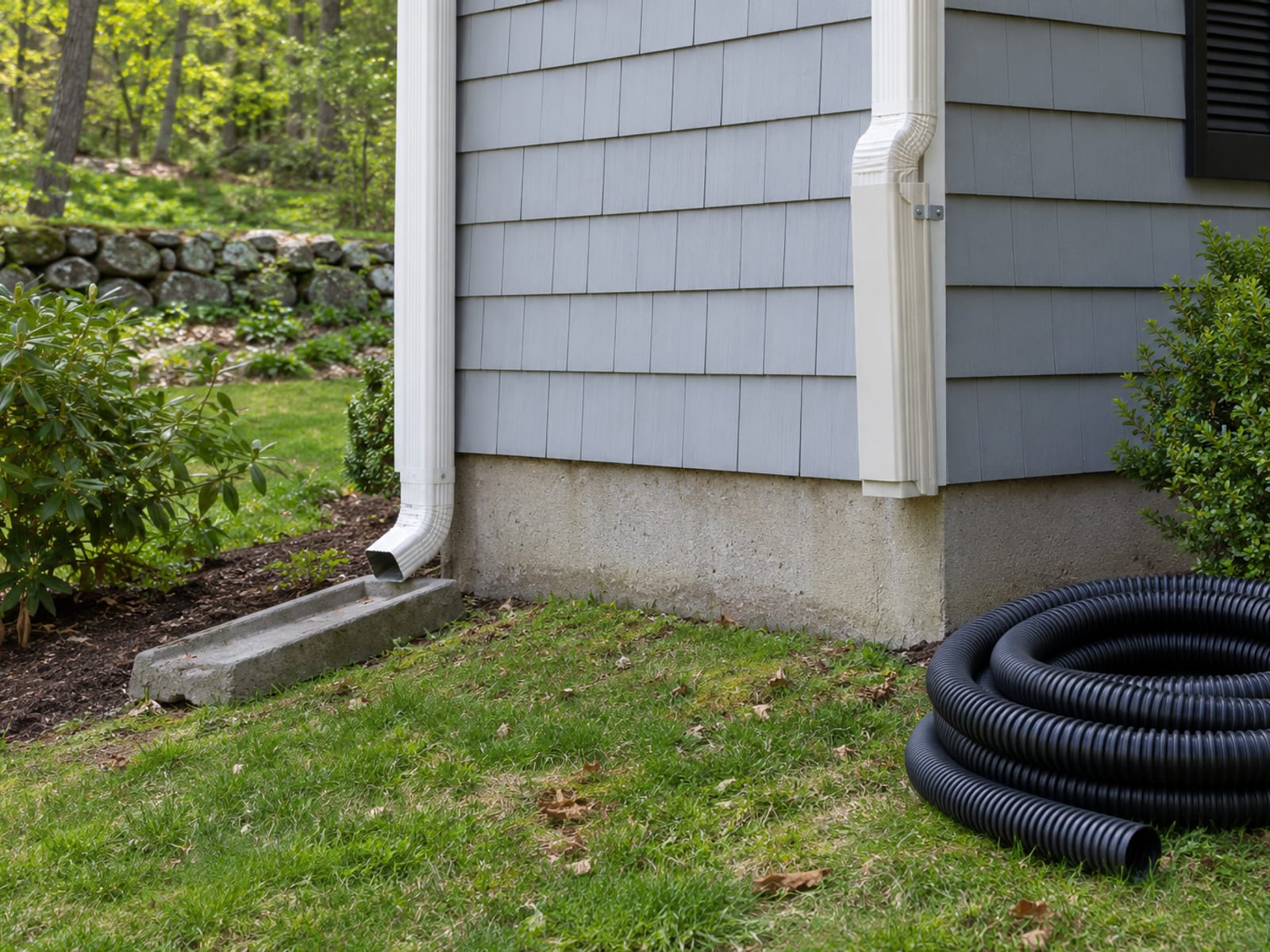
A splash block spreads the outlet flow over a wider area. It suits ground that slopes away from the house and has room for the water to spread. It is easy to see and easy to replace, but it will not carry water around a walkway, across a narrow side yard or over flat, poorly draining ground.
Rigid or flexible surface extensions move water farther across the lawn. They are simple to inspect, and they are generally less involved than a buried system. Their weak points are lawn equipment, snow removal, foot traffic and standing water that freezes when the run does not slope enough.
Flip-up and roll-out extensions
A flip-up extension can be raised for mowing or access. Its hinges and joints need a check now and then, and the end must still discharge to a good spot when it is lowered.
A roll-out extension unrolls in rain and rolls back up when it dries. Frost King's instructions for its Drain Away product recommend removing it in freezing climates, which makes it a seasonal product in Danbury rather than a year-round fix.
Underground drain lines
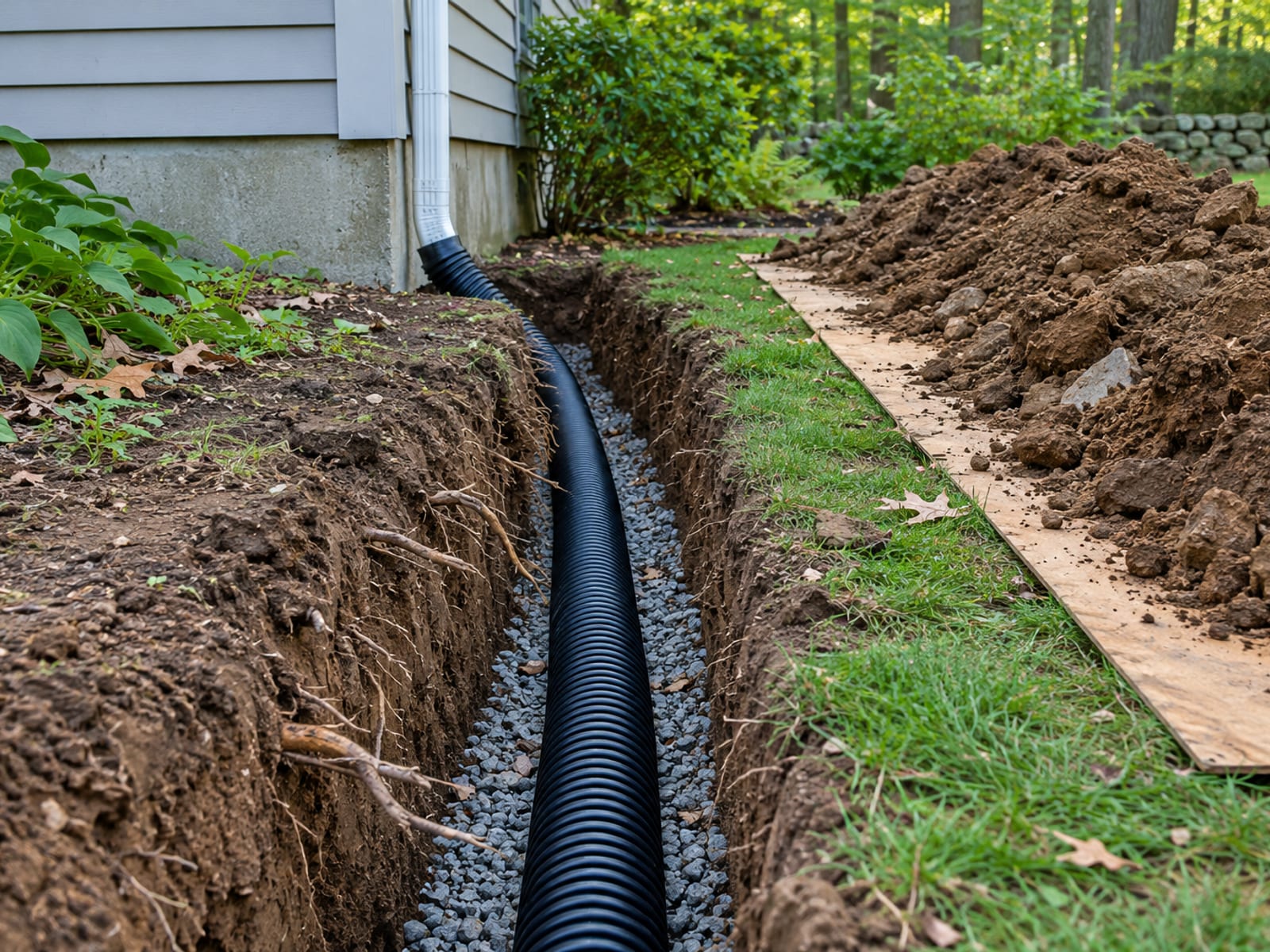
Buried pipe takes the visible extension off the lawn and can carry water to a daylight outlet, a pop-up emitter, a dry well or a rain garden. It needs a continuous route, enough slope, protection from roots and settling, cleanouts you can reach, and a destination that will not send water toward a neighbor or a street. Water left sitting in the pipe can freeze, so the line has to drain.
Dry wells and rain barrels
A dry well sends roof water into the ground below the surface. It needs soil that absorbs water, enough capacity, space between it and the foundation, and a plan for overflow. It is not automatically right for every Danbury lot.
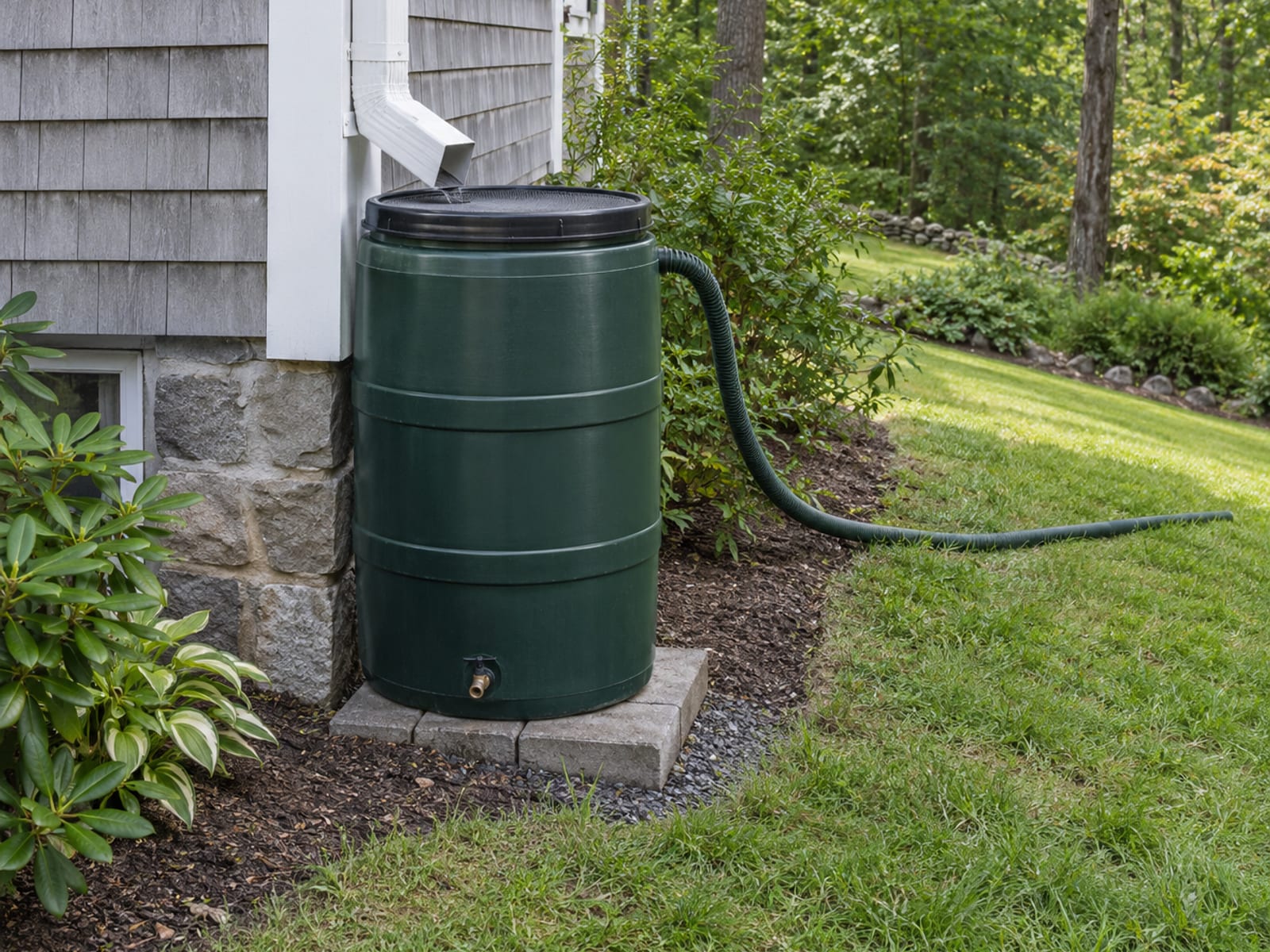
A rain barrel stores water for the garden. It needs a screened opening, a stable base, and an overflow that runs away from the foundation. In winter it needs its own handling plan.
Downspout Outlet Options Compared
Works Best When: The ground slopes away and there is room to spread water
Watch For: Narrow side yards, flat ground, walkways
Tap a factor to see how it moves the price.
Keeping Water Moving Through a Danbury Winter
NOAA's 1991 to 2020 climate normals for the Danbury station show an annual mean of 125.9 days at or below 32 degrees Fahrenheit. That is roughly a third of the year, so any drainage plan for your house should assume freezing, snow and ice. Repeated freeze and thaw also moves things, which is another reason to pick a system you can inspect each spring.
Different systems need different winter habits. A roll-out extension should come off when the manufacturer says so. A fixed surface run should slope so it empties after each storm, and it needs protection from plows and from piled snow. A buried line needs a downhill path and an outlet that will not pond, so water cannot sit in the pipe and freeze. Manufacturer instructions come first for any branded product, so keep the sheet that came with it.
When you review a proposal, ask how each outlet drains before a freeze and what happens to it under a snowbank. Those two questions tell you quickly whether the person who designed the run has thought about a Connecticut winter.
What Downspout and Extension Work Costs in Connecticut
The price of an extension, a buried drain, a dry well or a rain-barrel overflow at your house comes from a written, site-specific proposal. Published figures for related gutter and downspout work give you a frame of reference, with clear limits.
Published Figures for Gutter and Downspout Work
Published Figure: $4.85 to $8.79 per linear foot, average $6.82
Where It Comes From: ProMatcher, 2026
Tap a factor to see how it moves the price.
The ProMatcher Connecticut cost page and the HomeAdvisor guide to repairing gutters and downspouts describe gutter work and downspout parts. They are not a Danbury quote, and they do not price a buried line. A few dollars per downspout does not cover trenching a yard.
What Moves the Price of Downspout Drainage Work
Each outlet needs its own path
Tap a factor to see how it moves the price.
Ask for the proposal in writing, with the outlet named, before you compare totals. A low price that never says where the water goes is not really a price for drainage.
Danbury Rules, Older Homes and Tree Cover
Danbury's supplemental grading regulations say lots must provide positive drainage away from buildings. They direct that drainage on an individual lot avoid point discharges or concentrated runoff onto adjacent lots, as determined by the City Engineer, and they say surface drainage may not be discharged onto a City street without City approval. In plain terms, do not aim a downspout at your neighbor's yard or at the street.
Roof water also does not belong in the house sewer. Danbury's guidance on sewage backups tells residents to make sure gutters, downspouts and sump pumps are not connected to the sanitary sewer, because clean rain or groundwater can overload the pipe. Connecticut DEEP gives similar direction in its combined sewer overflow FAQ: roof leaders tied into a sewer should be disconnected and redirected to a lawn or rain garden. The city's stormwater page points to its rules on non-stormwater discharges.
Rules on where roof water may go differ by location. Before connecting to municipal infrastructure, or sending concentrated flow near a property line, confirm the outlet with the City. The Danbury Permit Center coordinates building, zoning, engineering and utility review at 203-796-1653, and inspections can be reached at 203-797-4581. Ask whether your exact scope needs a permit and who applies. The city's residential fee schedule lists a general residential fee of $22 for the first $1,000 of construction value plus $11 for each additional $1,000 or part of it, with a $0.26 per $1,000 state education fee, so ask which fee applies to the work you are planning.
Age plays a part too. Danbury's housing analysis reports that more than 67% of its housing was built before 1980, and a 2022 housing profile puts 46% before 1970. Older houses often have older grading and older gutters, so drainage trouble is common here and a thorough look at the whole roof-to-outlet path pays off.
Trees add leaf load and affect stormwater. Connecticut DEEP names Danbury among the communities with some of the state's lowest tree-canopy cover, and says rain and heat make urban trees relevant to managing stormwater. If your roof sits under mature trees, plan on regular gutter and downspout upkeep.
Reviewing a Proposal and Checking a Contractor
Connecticut requires home improvement contractors to hold a registration with the Department of Consumer Protection. You can confirm it on the state's home improvement page through the eLicense lookup, and the name on the registration should match the name on the contract. Applicants must carry at least $20,000 in general liability insurance to qualify, according to the DCP application information. Still ask for a current certificate of insurance that names the business you are hiring.
Here are questions worth asking before you sign:
- Where does every downspout discharge? And how many feet from the foundation does a surface outlet end?
- Where does a buried pipe end? And how will it drain before a freeze?
- What if the line meets roots, ledge, utilities or a walkway? The answer shows whether the route was walked.
- Does Danbury require a permit or approval, and who applies? The contract can say who pulls it, but you stay responsible for making sure it is handled.
- What happens to the dug-up soil and the lawn? Cleanup and restoration belong in writing.
- What is covered if an outlet freezes, clogs, settles or sends water toward a neighbor? Ask for the warranty terms.
- Will you include photos or a drainage sketch? A sketch makes the plan easy to check.
Manufacturer certification is not a legal requirement for ordinary extension work in Connecticut. It is still fair to ask which product instructions the installer follows and whether the installer has training on the product. If the problem looks bigger than a downspout, such as a foundation crack, a sewer connection or a lot that needs engineered drainage, a drainage, foundation, sewer or engineering specialist may need to be part of the fix. A short extension is not a cure for a larger grading or foundation-drainage problem.
If overflowing gutters are part of what is sending water down the wall, the gutter system and the downspouts and extensions below it are best looked at together.
Frequently Asked Questions About Downspouts and Extensions in Danbury, CT
How far should a downspout extend from the house?
ENERGY STAR and the Department of Energy give a benchmark of at least 5 feet from the foundation for surface discharge, and at least 10 feet for an underground catchment system. The International Residential Code's 5-foot provision is tied to expansive or collapsible soils or an approved drainage system. The final outlet also has to respect your grading, property lines, the street and winter conditions.
Do downspout extensions really work?
They do when they create a continuous path that carries roof water away from the foundation and ends in a suitable place. A short extension that ends in a low spot, against a wall, at a property line or in a frozen or clogged outlet does not solve the problem.
What is the best type of downspout extension?
It depends on your lot. A splash block suits sloping ground with room to spread water. A surface extension is simple to inspect. A buried line keeps the lawn clear and carries water farther, but it needs slope, cleanouts and a good destination. A dry well needs soil that absorbs water and an overflow plan.
Should I take my downspout extensions off for winter?
For a roll-out product, follow the manufacturer. Frost King's instructions recommend removing its Drain Away product where it freezes. Fixed, sloped systems have no single rule, but they need protection from plows, ice and frozen water, and you should check the instructions for your product.
Can I send my downspout water to the street or a neighbor's yard?
Not as a rule. Danbury's grading rules call for no concentrated runoff onto adjacent lots, and no surface drainage onto a City street without City approval. Gutters and downspouts should also stay out of the house sanitary sewer.
Do I need a permit to change my downspouts in Danbury?
It depends on the work. Ask the Danbury Permit Center at 203-796-1653 or the Building Department whether your exact scope needs a permit, and ask who applies. Your written contract can say who pulls the permit.
Downspout and Extension Knowledge Check
1. What is the benchmark distance from the foundation for surface discharge of roof water?
2. How does the International Residential Code's 5-foot provision apply?
3. Which of these should never receive your roof water?
4. Why do roll-out extensions need attention in a Danbury winter?
5. Who should you ask whether your exact downspout scope needs a permit?
Final Thoughts
A downspout extension earns its keep when it carries roof water at least 5 feet from the foundation across sloping ground, or farther through a buried line, and ends somewhere the water will not return. The outlet matters more than the length of the pipe, and Danbury's rules keep that outlet off the street, off a neighbor's lot and out of the sanitary sewer.
Getting this right protects the basement and the soil along your foundation, and it spares you from reworking the same corner of the yard each spring. A system that drains in winter and can be inspected is one you can keep up for years.
If water is gathering near your Danbury foundation, American Quality Roofing and Siding can come out and look at where your water goes. We are licensed and insured, CT HIC #0633301, CertainTeed ShingleMaster PRO certified, and rated A+ by the BBB, and we have served Central and Western Connecticut since 2006. Request a [free estimate/) or call us to schedule a visit to your Danbury home.
Serving Danbury, CT
This guide is part of our exterior work in Danbury. See our roofing contractor services in Danbury, CT.
Written by Jose Zaruma, American Quality Roofing and Siding.
← Back to the blog